In a Request for Proposal run with NEA to find smarter, easier-to-clean toilets, Changi Airport Group shared that it relied on more than 1,200 cleaners across Terminals 1 to 4, and that hiring the same number again for Terminal 5 wouldn’t be feasible (NEA).
Almost every high-traffic building in Singapore faces the same problem. Visitors expect clean toilets, cleaning manpower is getting harder to find, and a single bad toilet can end up in a Google review.
A smart toilet management system tackles this by replacing guesswork with data. This guide explains how the systems work, what they monitor, why urinals deserve particular attention, and what to look for when you specify one for your building.
What Is a Smart Toilet Management System?
A smart toilet management system uses a network of sensors to monitor a washroom in real time. The data goes to a dashboard and mobile app, so your facilities team knows when a toilet needs attention and what it needs.
Most buildings still clean on a fixed timetable, such as one check an hour, whether the toilet has had 5 visitors or 500. A smart toilet system switches that to on-demand cleaning. Cleaners are sent where they’re needed, when they’re needed.
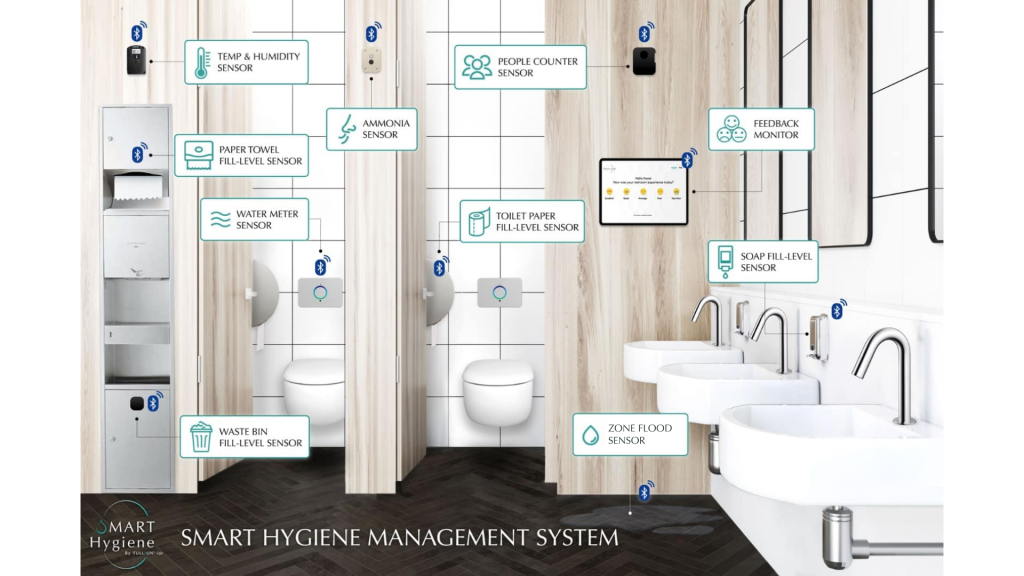
What the sensors monitor
| Sensor | What it tracks | What it tells your team |
|---|---|---|
| Ammonia (odour) sensor | Ammonia levels in the air | The toilet smells and needs cleaning now, often before anyone complains |
| People counter | Number of users | Which toilets are busiest and when, so you can plan manpower |
| Fill-level sensors | Toilet paper, paper towels, soap, bins | A dispenser is running low or a bin is full, so it can be topped up before it runs out |
| Wet floor sensor | Water on the floor | A slip hazard or a possible leak |
| Temperature and humidity | Air conditions | Poor ventilation that makes odour and mould worse |
| Smart water meter | Water consumption | Leaks, non-stop flushing and unusual water usage |
| Feedback panel | Ratings from users | How users rate the toilet, logged and time-stamped |
Why Singapore Buildings Are Making the Switch
1. Cleaning manpower is getting harder to find
Cleaning in Singapore depends heavily on manpower that is increasingly hard to hire and keep, which is why NEA has actively sought solutions that reduce reliance on cleaning manpower (NEA). Smart systems don’t replace cleaners. They make each cleaner more effective by removing unnecessary checks, so the same team can cover more toilets without lowering standards.
2. Nothing runs out
Running out of toilet paper or soap is one of the most common washroom complaints. In the same NEA call for proposals, Marina Bay Sands said it wanted systems that alert cleaners when consumables need refilling, instead of relying on hourly stock checks (NEA). Fill-level sensors do this automatically.
3. You find out about problems before users do
Odour, overflowing bins, leaks and wet floors trigger alerts straight away. Your team fixes the problem before it turns into a complaint, a bad review or a safety incident.
4. You have data to back up your decisions
Traffic patterns show where to put cleaners, which toilets need upgrading and when to schedule maintenance. Digital records also replace paper checklists, which is useful for audits, clients and certifications such as the Restroom Association (Singapore)’s Happy Toilet Programme, which grades public toilets from 3 to 6 stars (Restroom Association (Singapore)).
Don’t Overlook the Urinal
In a smart washroom, the urinal matters more than most people expect.
In most male and public toilets, urinals are the main source of the ammonia smell. When urine splashes or builds up in the trap and drain, the urea in it breaks down into ammonia, the sharp odour people link with a dirty toilet (Compound Interest). That’s why the ammonia sensor is often the most useful sensor in a smart toilet system: in practice, it tells you how your urinals are performing.
Smart monitoring and the right urinal fittings work best together.
Choosing the right urinal
- Sensor-flush urinals: a touchless infrared flush activates after each use. It’s more hygienic than a manual flush valve and makes sure every use gets flushed, which reduces odour build-up.
- Low-flow and waterless urinals: these cut water use significantly. Waterless urinals remove the flush altogether, but they need a proper cartridge maintenance routine.
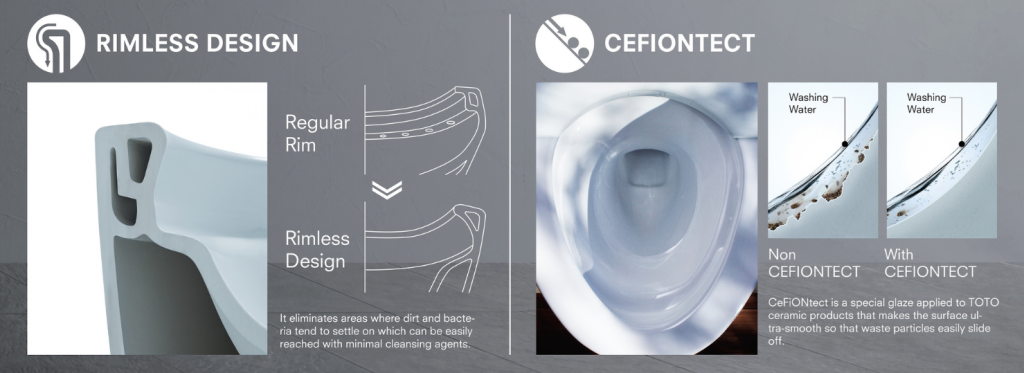
- Easy-clean shapes and glazing: fewer crevices and a smooth, non-porous surface mean less residue and faster cleaning.
- Smarter flushing with IPEE Mini: Using sodium detection instead of conventional infrared sensing, IPEE Mini detects actual urinal use to help prevent false flushes and unnecessary water consumption. It also carries a 3-tick WELS rating and features Stadium Mode for more efficient flushing during periods of high usage.
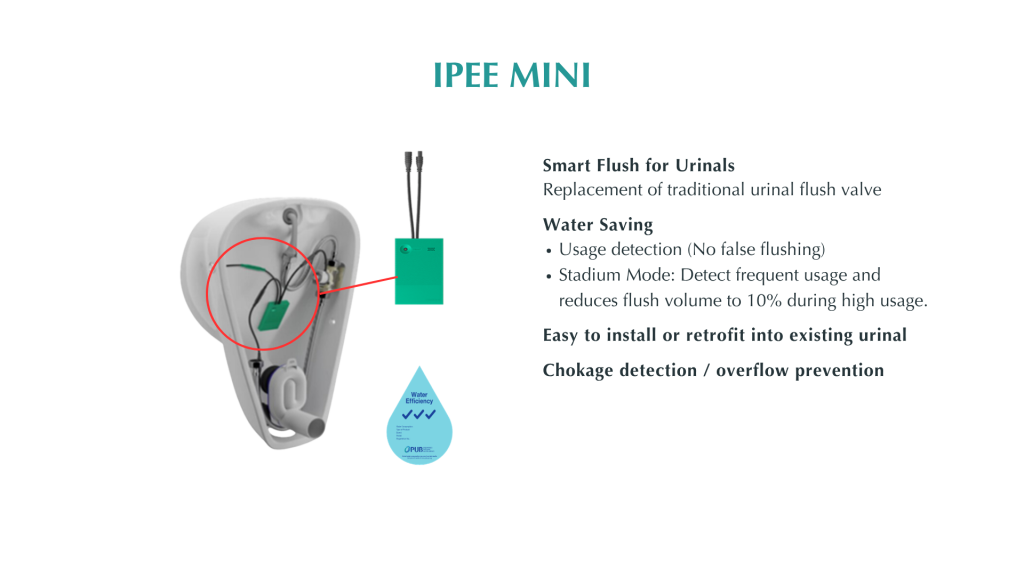
WELS requirements for urinals
Under PUB’s mandatory Water Efficiency Labelling Scheme (WELS), urinal flush valves and waterless urinals must carry a WELS label (PUB):
| WELS rating | Urinal flush volume | Water savings |
|---|---|---|
| ✔✔ 2 ticks (Very Good) | More than 0.5L to 1.0L per flush | 40% |
| ✔✔✔ 3 ticks (Excellent) | 0.5L or less, or waterless | 60% |
Source: FullSun WELS guide
For a building with dozens of urinals and thousands of daily users, the difference between 2 and 3 ticks adds up to a real saving on the water bill every month.
FullSun tip: If the ammonia readings for a toilet stay high even after it’s been cleaned, the cause is usually the fitting, not the cleaning. Common culprits are old urinals, a blocked trap or poor drainage. Smart data helps you tell a cleaning problem apart from an equipment problem.
FullSun’s Smart Hygiene Management System
FullSun has supplied sanitary ware to Singapore’s hospitals, commercial buildings and public facilities since 1995. Our Smart Hygiene Management System (details) combines that experience with real-time monitoring, so we can supply both the fittings and the system that manages them.
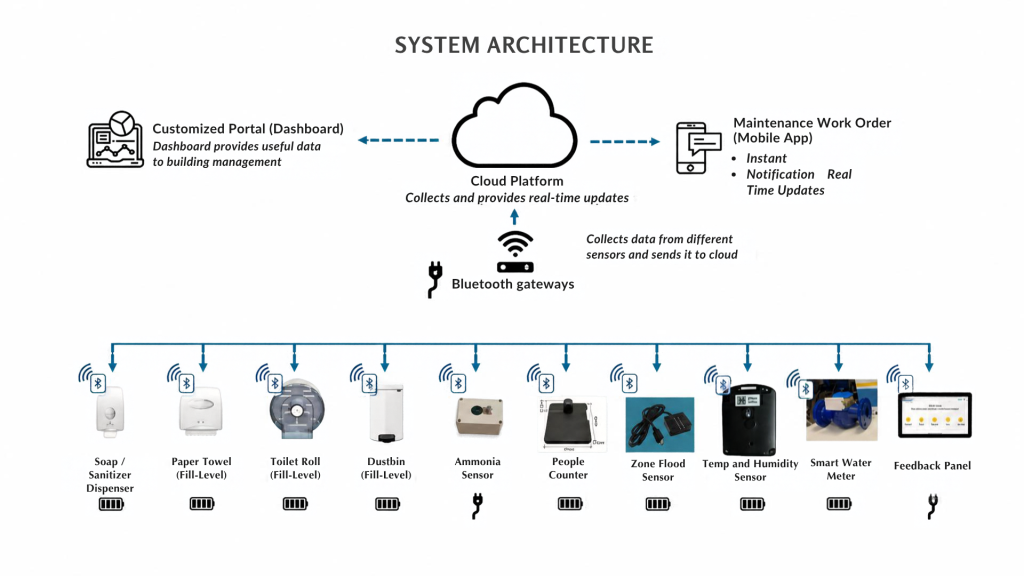
How it works:
- Sensors for ammonia, people count, consumables and bins send data over Bluetooth low energy (BLE), Wi-Fi and other networks
- Your team sees live status on a web dashboard and mobile app
- Alerts go out when a toilet needs cleaning or a top-up, and cleaning can be scheduled around actual usage
- Your FM team is notified straight away of leaks, breakdowns or other hygiene issues
Built for high-traffic places: airports, shopping malls, stadiums, hospitals, schools and office buildings.
Already in use in Singapore
Case studies from FullSun.
- Khoo Teck Puat Hospital, “Iconic Toilet”: ammonia sensors, people counters, trash bin sensors, and soap and toilet paper fill-level sensors monitor cleanliness remotely.
- Far East Flora Building: FullSun supplied both the sanitary ware and the smart hygiene system, including ammonia, people counter, trash bin, water meter and fill-level sensors, to support a preventive maintenance plan.
Simple monthly plans
Pricing as published on FullSun’s website; please confirm current rates.
| Plan | What’s included | Price |
|---|---|---|
| Essential | Wet floor sensor, feedback panel, ammonia sensor, temperature and humidity sensor, people counter, standard analytics report, | $179 / toilet / month (Customisable based on selected sensors and site requirements) |
| Plus | Everything in Essential, plus fill-level sensors for toilet paper, paper towels, soap and bins | $299 / toilet / month |
| Custom | Everything in Plus, plus a smart water meter, customised analytics report and 8 user logins | Contact us |
How to Choose a Smart Toilet System: A Checklist for Facility Managers
Before you sign with any provider, ask:
- ☐ Does it cover all the pain points? Odour, consumables, bins, leaks and user feedback, not just one sensor.
- ☐ Can it be retrofitted? Can it be added to your existing toilets without hacking or long closures?
- ☐ How does it connect? BLE, Wi-Fi or LoRaWAN. Check coverage in basements and toilets on multiple floors.
- ☐ Who gets the alerts, and how? Alerts should reach cleaners on the floor, not just the office.
- ☐ What reports do you get? Usage trends, response times and history that you can show management or clients.
- ☐ Are your fittings up to standard? The system shows you problems, and the fittings have to fix them. Check urinals, flush valves and cisterns for WELS compliance.
- ☐ Does the supplier know washrooms, not just sensors? A provider who understands sanitary ware can tell you whether a problem is cleaning, equipment or design.
Make Every Toilet in Your Building a Clean Toilet
A smart toilet management system gives your team the information to keep every washroom clean, stocked and odour-free with the manpower you already have. When you pair it with efficient, easy-clean fittings such as sensor-flush urinals and WELS-rated cisterns, you improve the whole washroom, not just the monitoring.
Talk to FullSun about a site assessment for your building.
FullSun Marketing Pte Ltd
146 Jalan Besar, Singapore 208864
Mon–Fri: 8:30am – 7pm | Sat & Public Holidays: 9:30am – 7pm
Sources
- NEA, Questions & Answers for the Request for Proposal on the Smart & Easy-to-Clean Toilet (undated; estimated c. 2018–2019): https://www.nea.gov.sg/docs/default-source/default-document-library/qnas_rfp-for-smart-and-easy-to-clean-toilet.pdf
- FullSun, Smart Hygiene Management System: https://fullsun.com.sg/smart-hygiene-management-system/
- FullSun, WELS Rating: https://www.fullsun.com.sg/wels-rating/
- PUB, About the Water Efficiency Labelling Scheme (WELS): https://www.pub.gov.sg/wels/about
- Restroom Association (Singapore), Happy Toilet Programme: https://www.toilet.org.sg/happytoilets
- Compound Interest, The Chemistry of the Smell of Toilets & Human Waste: https://www.compoundchem.com/2015/06/02/toilets/